
What is a One-Way Bearing? Working Principle, Types & Applications
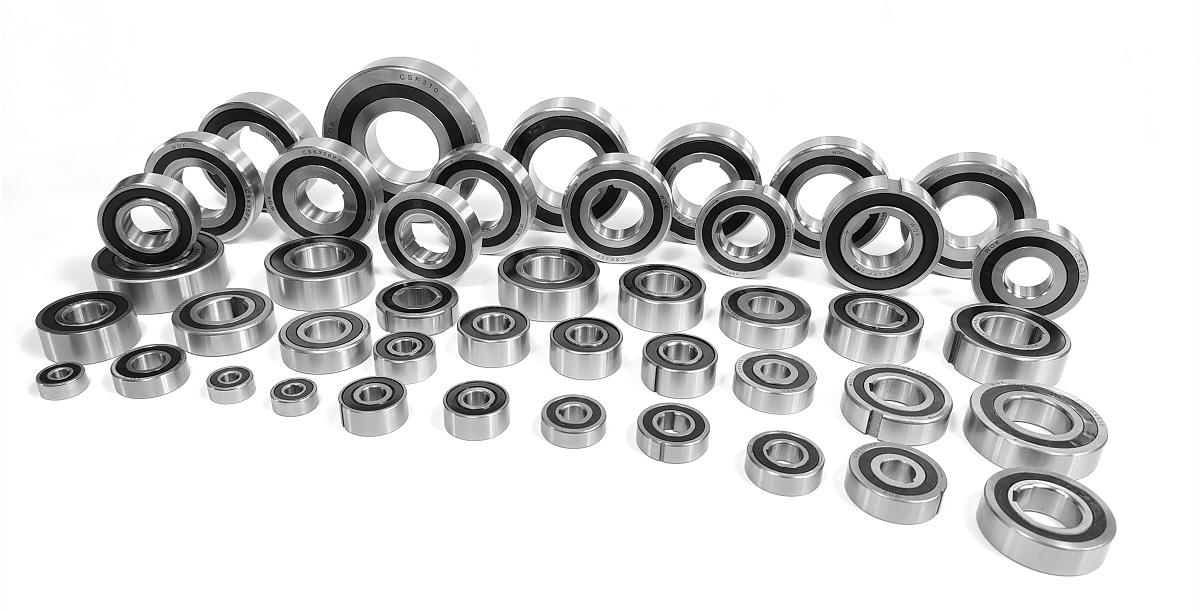
Have you ever wondered: why do bicycle pedals only drive the wheel in one direction, while pedaling backwards does nothing? Why doesn't the starter motor get damaged by high-speed reverse rotation after the engine starts? Behind these ingenious functions lies a precision mechanical component — the one-way bearing, also known as an overrunning clutch. Its core capability can be summed up in one sentence: free rotation in one direction, immediate locking in the opposite direction.
1. How Does It Work? (Using the Sprag Type as an Example)
The one-way bearing operates entirely on a purely mechanical "wedge effect," without relying on any electronic or hydraulic system. Its internal structure includes:
Outer race: Usually fixed, for example, mounted in a bearing housing.
Inner race: Connected to the shaft that requires one-way transmission.
Sprags: A group of specially shaped metal blocks, gently pushed up by tiny springs, evenly arranged in the raceway between the inner and outer races.
The working process has two states:
1. Free Rotation (Allowed Direction)
Assume the inner race is allowed to rotate clockwise. Friction drives the sprags to rotate along, but due to their unique profile, the sprags are "squeezed" toward the wider side of the raceway. At this point, a tiny gap appears between the inner race, sprags, and outer race, and the inner race can spin freely with almost no torque transmission.
2. Reverse Locking (Locked Direction)
When the inner race attempts to rotate counterclockwise, friction pushes the sprags toward the narrower side of the raceway. Aided by the springs, the sprags quickly wedge into the gap between the inner and outer races — like placing a triangular stone under a wheel. The sprags are firmly stuck, and the inner and outer races instantly become a rigid connection. Reverse torque cannot be transmitted, and the shaft is firmly locked.
2. Other Common Types
In addition to the sprag type, there are two other classic structures in engineering:
Ramp and roller type: Similar principle, but the sprags are replaced with cylindrical rollers. During reverse rotation, the rollers are squeezed into the narrow end of the ramp, achieving self-locking.
Ratchet and pawl type: Older and more intuitive. A toothed ratchet wheel plus a spring-loaded pawl. During forward rotation, the pawl slides over the tooth tips (making a "clicking" sound), and during reverse rotation, it engages into the tooth grooves. Commonly found in manual wrenches and bicycle freewheels.
3. Three Core Functions
One-way transmission: Transmits torque in only one direction.
Reverse locking: Prevents the mechanism from reversing, for example, a jack preventing a heavy object from falling.
Overrunning function: When the driving member decelerates or stops, the driven member can "overrun" and continue rotating freely. The most typical example is coasting on a bicycle — you stop pedaling, but the wheel continues to roll forward.
4. Applications Everywhere
Bicycle freewheel: Pedaling drives forward motion, coasting allows free overrunning.
Automotive starter: Drives the engine during starting; after the engine starts, the starter is "overrun" and disengaged, preventing burnout from being dragged in reverse.
Industrial machinery: Anti-reverse and intermittent motion control in textile, packaging, and printing equipment.
Lifting equipment: Anti-fall locking in jacks and winches.
Motorcycle starter plates, gearboxes: One-way clutch applications.
5. Summary
A one-way bearing is essentially a mechanical "one-way valve" — except it controls rotational motion instead of fluid. By utilizing the self-locking effect created when sprags (or rollers) are "wedged" in a specific direction, it simply, reliably, and efficiently achieves "forward only, no reverse" rotational control, making it an indispensable fundamental component in modern machinery.
Bangni Transmission Technology (Changzhou) Co., Ltd. — Focused on the R&D and manufacturing of one-way bearings and clutches, providing reliable precision transmission solutions for global customers.